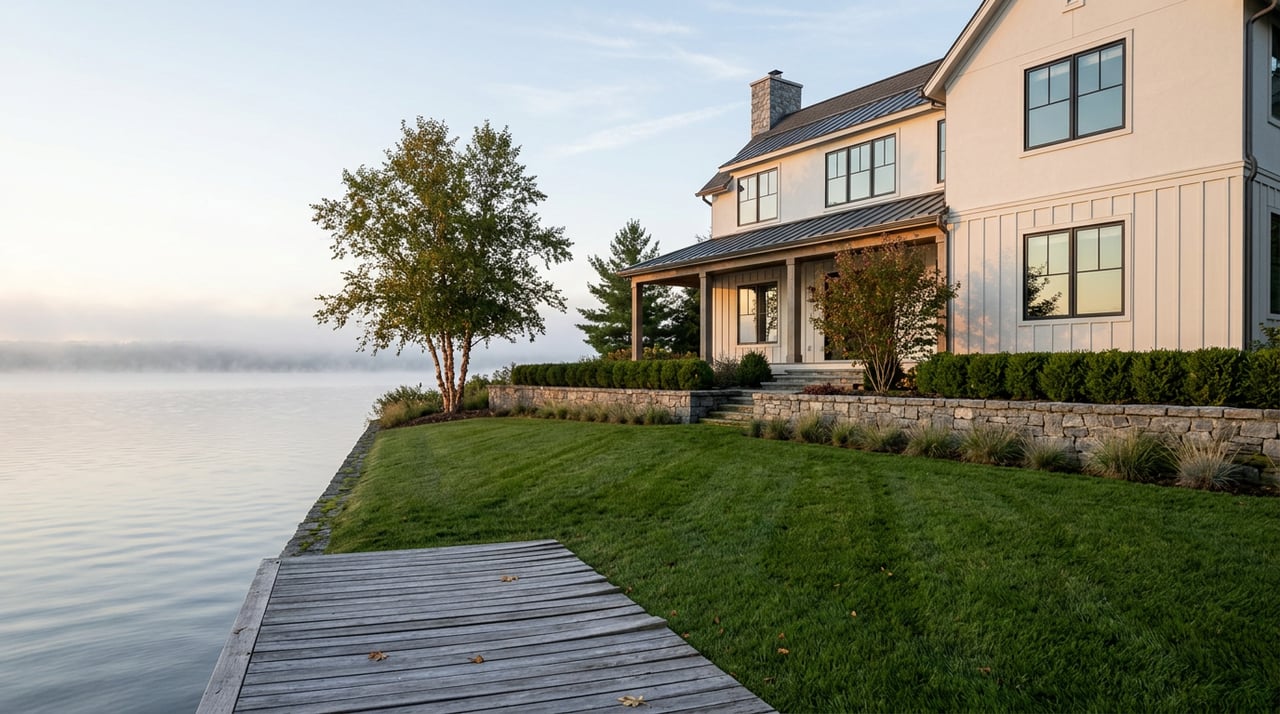
Buying Lakeshore in Orono: What the Deed Doesn't Guarantee
September 10, 2026
September 10, 2026
In 1984, Anne and David Duff signed a quitclaim deed handing a narrow strip of their Orono lakeshore over to the city. In exchange, they kept one thing: the right to put a dock and a boat buoy in Lake Minnetonka from that spot. Four decades later, that single clause is still being argued over by a former Orono mayor, the city attorney, and a real estate agent who bought the rights from the Duffs' heirs believing he'd bought lake access outright. Nobody in that fight is arguing over the house. The house changed hands years ago. They are arguing over a right that has nothing to do with whose name is on the deed to the land.
That distinction, more than square footage or finish level, is the thing that actually separates one Orono lakeshore listing from another.
In Minnesota, riparian rights, the legal ability to use and enjoy the water in front of a property, don't automatically travel with the house the way a furnace or a foundation does. State law allows a landowner to sell or assign those rights separately from the land itself, which is exactly what happened on Shoreline Drive in Orono. The land went to the city. The docking and buoy rights stayed with the Duff family, then passed through their estate, and were eventually sold to a buyer who has spent years trying to actually use them.
Most Orono transactions never reach this level of dispute. But the underlying mechanic is the same on every lakeshore parcel in town: owning shoreline gives you the ability to apply for a dock permit through the Lake Minnetonka Conservation District. It does not, by itself, guarantee you'll receive one, and it doesn't tell you whether a previous owner already sold, shared, or encumbered that right long before you ever toured the house.
The timeline is worth knowing because it shows how quietly this kind of thing can sit dormant. The heirs' contact with the buyer began in 2019. A purchase agreement for the water rights followed in 2020. A deed transferring title to those rights was signed in 2021. In August of 2022, the buyer applied to the LMCD for a multiple dock license, and that application is what pulled Orono officials and neighbors into a fight that has now run for years.
"I saw Lake Minnetonka lakeshore and I knew I wanted it."
That's how the buyer, Dan Gustafson, described his decision to the Star Tribune. A neighbor who'd also tried to buy the same rights estimated that a dock with a dozen slips could bring in more than $10,000 a year per slip, which is a useful reminder that these disputes aren't sentimental. They're about a specific, monetizable right that exists independently of whatever house happens to sit nearby.
Whether or not a property has ever been part of a dispute like the Duff case, every lakeshore owner in Orono is working within the same code:
None of this changes based on what the house looks like. A rebuilt estate on Bracketts Point and a modest cottage tucked into Stubbs Bay are both measured against the same 8-foot rule and the same setback formula. What changes bay to bay is exposure, water depth, and how much of the shoreline has already been converted from summer cottages to year-round estates, which is a real difference in Orono but a separate question from whether a given lot's dock rights are clean.
Orono's lakeshore stock skews older, and a meaningful share of it still runs on private septic rather than municipal sewer. Here's where a second gap between what's required and what's actually enforced shows up.
| Requirement | Hennepin County | Typical mortgage lender |
|---|---|---|
| Disclose septic system at sale | Required by state law | Required |
| Compliance inspection at sale | Not required, disclosure only | Often required before closing |
| Certificate validity | 3 years for existing systems, 5 years for new installs | Lender sets its own cutoff |
Hennepin County doesn't require a compliance inspection at the point of sale, only that the seller disclose the system's existence and condition to the best of their knowledge. That's a lighter touch than some neighboring counties. But a disclosure isn't the same thing as an inspection, and most lending institutions know the difference. A well-informed buyer, and nearly every underwriter, will want a licensed inspector to open the tank, check for a failing drainfield, and issue an actual Certificate of Compliance before the loan closes. On a 30- or 40-year-old system, that inspection can turn up a repair timeline that changes the negotiation entirely.
A few things worth confirming before a purchase agreement goes out on Orono lakeshore:
Does owning lakeshore in Orono guarantee a dock permit? No. Ownership gives you standing to apply through the LMCD. Whether the permit is granted depends on setbacks, existing licenses on the site, and whether the riparian rights attached to that parcel are actually intact.
Will Hennepin County require a septic inspection to sell my Orono home? The county requires disclosure of the system's existence and condition, not a mandatory inspection. Many lenders require one anyway before approving the buyer's financing, so it's worth arranging early rather than as a closing-week scramble.
Can a dock right really be sold separately from the house? Yes, and it can resurface years later. Riparian rights in Minnesota can be assigned independently of the land they're attached to, and old severances sometimes only come to light when a new owner applies for a permit or a title search turns up a decades-old quitclaim deed.
A listing sheet that reads "150 feet of frontage" is a starting point, not the finished picture. The actual product being sold on Orono lakeshore is the paper behind that number: who holds the riparian rights, what the LMCD has on file, and how recent the septic report is. That's the part worth checking before an offer goes in, not after.
If you're circling a property on Crystal Bay, Stubbs Bay, or anywhere else along Orono's shoreline, Let's Connect before you write the offer.
Stay up to date on the latest real estate trends.

Johnny combines deep local knowledge, innovative marketing, and personalized guidance to help clients achieve their real estate goals with confidence.